
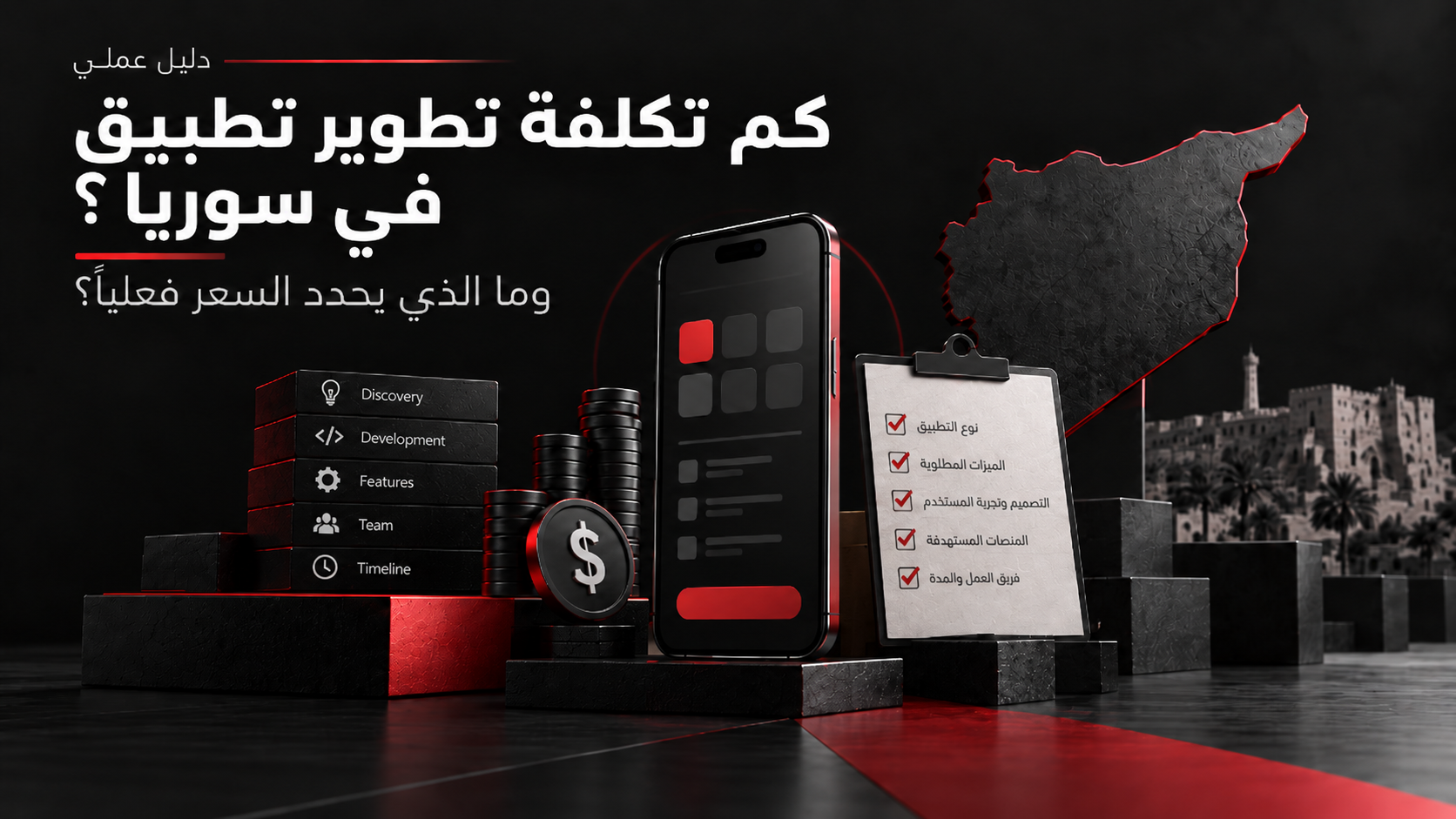
There is no professional answer to “How much does an app cost in Syria?” as a single number. A simple booking app, a multi-sided marketplace, and an e-commerce app connected to inventory and payments are all “mobile apps,” but they are fundamentally different projects in analysis, architecture, testing, and operations. The useful question is therefore not “What is the app price?” but “What must the product actually do, for whom, on which platforms, and with which systems?” Once those elements are defined, cost becomes a business estimate that can be defended rather than an attractive early number that changes after development begins.
1. Why There Is No Single Price for an App
Most of an application's cost is not determined by screen count alone. It comes from the behavior behind those screens. A login screen can be simple with email and password, or more involved with phone verification, roles, permissions, social login, and organization accounts.
The same applies to an “admin panel.” A page that lists orders is different from an operational system with staff permissions, inventory, reporting, approvals, and audit trails. Comparing two proposals only because both say “app + admin panel” is usually not a valid comparison.
- Number of user types and roles.
- Number of critical user journeys.
- Backend and database complexity.
- External integrations such as payments, maps, and messaging.
- Performance, security, and offline requirements.
2. What Actually Changes Development Cost?
The first driver is scope. Do you need only a customer app, or customer and provider apps plus an admin portal? Are there identity checks, bookings, orders, payments, notifications, chat, or maps?
The second driver is customization. Standard components and common workflows are faster than bespoke experiences or unusual operational logic. The third driver is operational quality after launch: backups, monitoring, logs, error handling, analytics, and recovery procedures are not always visible to users, but they are part of a real product.
- Custom UI/UX versus standard interfaces.
- Android only versus Android and iOS.
- One app versus several apps or portals.
- Simple local data versus multi-branch centralized systems.
- API integrations with existing systems.
- Advanced reporting, permissions, and approvals.
3. Do Android and iOS Double the Cost?
Not necessarily, but supporting two platforms adds real work in development, testing, release, and support. Even with Flutter or React Native, each operating system has its own behavior, configuration, store requirements, and device matrix.
If one platform can validate the first market, starting there may be economically smarter. If users clearly span both platforms, support should be planned from the beginning rather than treated as a free second copy.
- Testing devices and OS versions.
- Developer accounts, signing, and certificates.
- Notification and permission differences.
- Store review and release management.
5. What We Need to Estimate Your Project Properly
The clearer the initial information, the less guessing enters the proposal. You do not need a technical specification; we need to understand the problem, users, critical journeys, and how the business operates today.
It also helps to clarify whether an existing system must be integrated, how payments work, who manages content or orders, and which countries and platforms are targeted. These questions prevent discovering half the project after coding has started.
- 1Who are the primary users?
- 2What are the 3–5 most important tasks they must complete?
- 3Is there an admin panel, and what must it control?
- 4Are there payments, maps, notifications, messaging, or integrations?
- 5Is there an existing system or database?
- 6Which platforms are required in the first release?
- 7What should happen when internet connectivity or an external service fails?
6. How to Recognize a Professional Software Quote
A strong proposal makes scope understandable. You should know what will be built, the stages, assumptions, exclusions, change process, and what you receive at handover. A low price without these details may simply mean that important work has not been counted.
At The Drix, we prefer to analyze the project scope before locking the final number, especially when operations, integrations, or multiple user types are involved. A useful first step is to share the problem, current workflow, and intended outcome so the idea can be converted into a scope that can actually be estimated and compared.
- Clear scope and defined outputs.
- Reviewable milestones and deliverables.
- Third-party services and recurring costs identified.
- A clear process for out-of-scope changes.
- Support, maintenance, and asset ownership clarified.
Limitations
This article does not provide fixed prices because actual cost depends on scope, technical and operational requirements, quality expectations, and third-party services. Any number without sufficient analysis may be misleading.